THREE02 / 02
CHAPTER 02
The Number Heap
Fiction. Includes violence, injury and survival hardship.
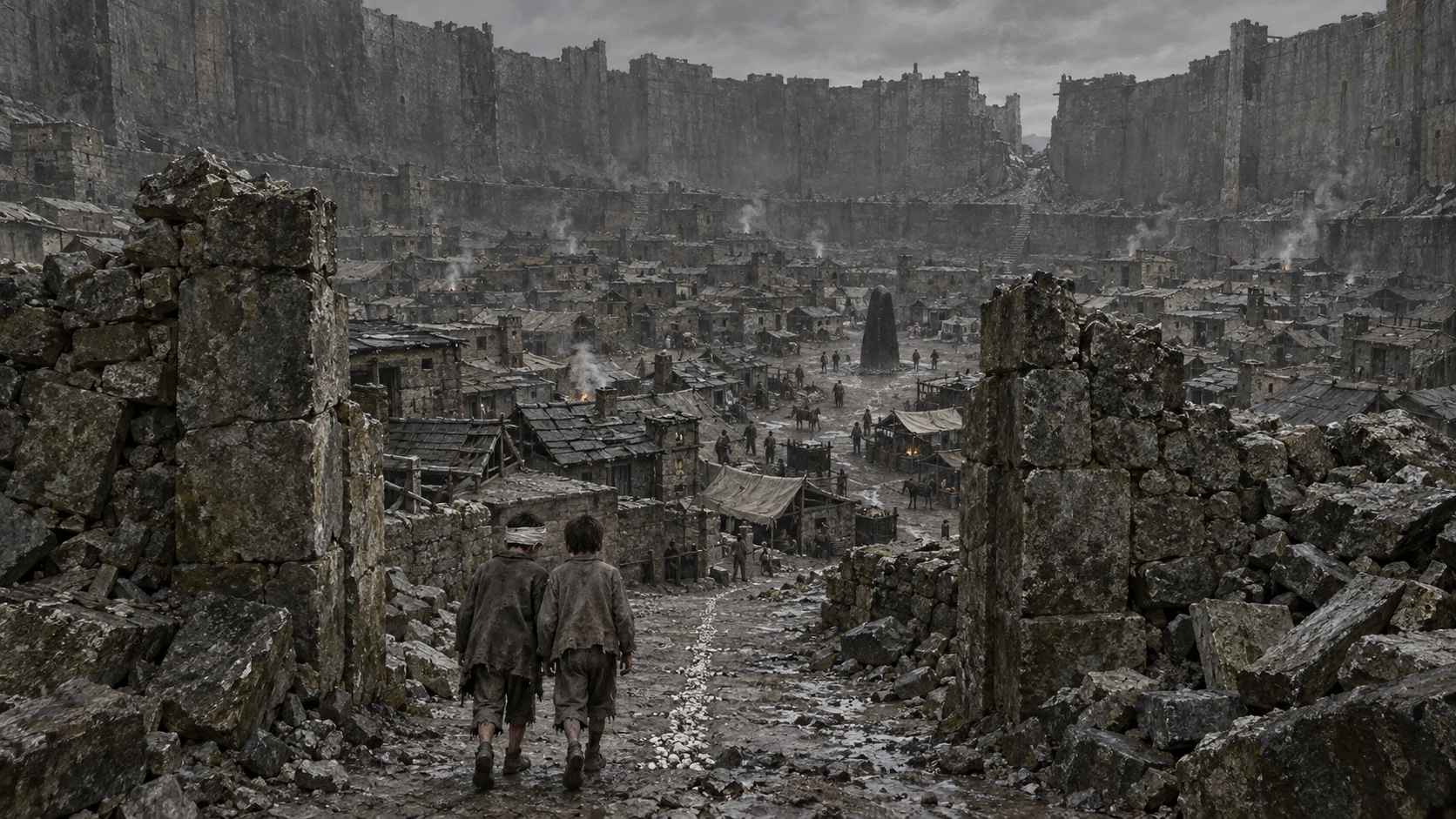
Once we squeezed out of the narrow gap, the path began to slope steadily downward.
7 walked ahead, and I held the back of his clothes. My head didn't hurt as badly as when I'd first woken, but every few steps, the spot above my ear would swell and throb with my pulse.
We passed through a breach in one wall, then another.
The paths here all looked much the same.
Tall gray walls pressed in from both sides. In some places, you had to turn sideways to squeeze through. In others, the passage suddenly opened wide enough to hold dozens of people, only to end at another wall a little farther on. Cracks and black water stains covered every surface. Some walls were so high you couldn't see the top. Others had mostly collapsed, leaving rubble heaped along the path like waves frozen in place.
When I was small, I thought everywhere was like this.
Behind a wall, another wall.
At the end of a road, more road.
Sometimes people left marks on the walls: a horizontal line, a circle, or a few stones stacked in a particular order. They weren't meant for anyone else. They were messages to yourself on the way back. You remembered them going in, then found them again, one by one, coming out.
Miss one, and you might turn down a different path and never find your way out.
7 reached a fork and turned left without even slowing down.
I followed him a couple of steps, then suddenly asked:
“How do you know it's this way?”
He turned and gave me the look he saved for when I'd said something stupid.
“Did 4 knock all the sense out of you?”
“I'm just asking.”
“We came this way a minute ago.”
He started walking again.
I stared at the two almost identical passages. My mind was still blank.
“Then why not the right?”
7 stopped.
He pointed to the foot of the wall on the left.
A triangular white stone was wedged there.
Then he pointed right.
Nothing.
“You put that there,” he said.
I blinked.
“Me?”
“After we got lost last time. You said whoever took the wrong turn again was a 0=1.”
I stared at the stone, and the memory slowly caught up.
So I had.
We'd gone round and round this area that day, until we were too hungry even to swear. When we finally found the right path, I'd snatched the white stone off the ground in a rage and jammed it into the wall with both hands.
I couldn't help laughing a little.
My head hurt immediately.
“Sss—”
7 didn't turn around.
“Serves you right,” he said over his shoulder.
“Weren't you afraid I was going to die just now?”
“Not anymore.”
“Why?”
“If you can still follow me around being annoying, you'll live.”
I tried to kick him from behind. My leg was only halfway up when the ground swayed again. I put my foot down and followed him properly.
Two more turns, and the path suddenly widened.
There were no longer two unbroken walls ahead of us.
It looked as though something had once smashed its way through the middle. Great sections of wall had fallen inward, spilling rubble down the slope. Farther on, stone houses crowded up through the debris, their roofs at different heights. Some were covered with blackened scraps of timber. Others simply had slabs fallen from the walls piled in layers on top.
A few threads of smoke escaped through gaps in the roofs, carrying the smell of wet wood and the bitterness of burnt food. Before they rose very far, they dissolved into the eternally gray sky.
Suddenly there were people everywhere too.
Someone sat carving something in a doorway. Someone else sifted dirt from a heap of rubble. A group of children fought over water in a large chipped jar. Farther away, a man dragged home a bundle of wood pulled from who knew which wall, two barefoot children following behind.
Sounds and smells came at us from every direction.
People arguing.
People calling out.
Coughing.
And someone's child crying.
When I'd first woken, those sounds had seemed like a pack of animals howling in a narrow hole.
Now each sound belonged to someone. Even the crying child was reassuring.
Only then did I really feel I was back.
This was Number Heap 9.
We usually just called it “the Heap.”
As for why it was called a Number Heap, I'd asked Grandpa when I was small.
He'd been fixing the roof. All he said was:
“A heap of people with nothing but numbers for names, all living together. What else would you call it?”
I thought that was a lazy answer, so I asked why it was number 9.
Grandpa said:
“Because there were eight before it.”
I asked where the other eight were.
He went quiet for a while.
In the end, he just handed me the stone he was holding and told me to keep a firm grip on it, and my mouth shut while I was at it.
I understood later. It wasn't that he didn't want to answer. He didn't know either.
Nobody did.
We knew we lived in Number Heap 9, and we knew there were other Heaps far away. Occasionally, someone from outside found their way here alive. When they gave their name, they put their Heap's number in front of their own.
Take me.
Here, I was 3.
If I went to another Heap, I would be 9-3.
7 would be 9-7.
And that bastard with the club would be 9-4.
Your Heap's number and your own, put together. That was all the identity you could carry anywhere else.
At least, that was what everyone had always believed.
We headed down from the entrance.
There wasn't actually a gate.
Two broken stone pillars stood there, with a line of white gravel laid across the ground between them. Beyond that line lay the Maze, where people disappeared. Only after crossing it were you truly back in the Heap.
4 was already there.
He stood inside the white line, talking to someone older than us. The club he'd hit me with still hung from his hand. When he saw 7 and me coming down, he glanced our way.
I slowed without thinking.
7 saw him too. He said nothing, just edged half a step closer until his shoulder almost touched mine.
4 didn't come over.
He just watched me.
From a few paces away, he raised the club and tapped it leisurely against his shoulder twice. Then he tilted his chin toward the other side of the white line.
I knew what he meant.
He was telling me this wasn't over. We'd settle it outside.
But as long as I stayed inside the white line, he wouldn't dare touch me.
The Heap had its rules.
Whatever fighting happened outside had to stop once you crossed that line.
Out in the Maze, you could beat someone until they couldn't get up, steal the food they'd found, or make an enemy for life. You could even kill them, though it would ruin your reputation. But the moment you stepped into the Heap, you had to leave all your hatred outside the white line.
1771 had made that rule. It was how people survived together here.
Nobody knew how long it had been in place.
It had been there as far back as I could remember.
Some people had refused to accept it.
Those people had been driven out of the Heap.
To us, there was no punishment worse than being cast into the Maze.
The walls outside wouldn't open a path just because you were sorry.
And they wouldn't bring you back across the white line because you were starving.
I stepped over the line and pulled a face at 4.
7 grabbed my head and turned it forward.
“Did you have to wind him up again?”
“He can't hit me in here.”
“What about next time you go out?”
“Next time I'll bring a club too.”
“You couldn't even keep a creature away from him. What's a club going to do?”
“I wasn't ready.”
7 sighed.
“You say that every time you get beaten up.”
We continued down the slope.
The closer we got to the center, the more tightly the houses crowded together.
The whole Heap was like an enormous stone bowl sunk between the high walls. Nobody knew what the place had once been. We only knew that the walls around it, so tall you couldn't see where they ended, were older than the oldest person in the Heap.
Some said no one had built the Heap at all.
People had simply crawled in afterward and made themselves at home.
The fallen walls provided stone for houses. The low ground held rainwater. Along the few paths nearby that had been explored, you could sometimes find 0=1, wood to burn, and things to eat that didn't look much like food.
So more and more people came.
Until it became what it was now.
Over a thousand people, all squeezed into that stone bowl.
It sounded like a lot, but the space we occupied wasn't very big.
From the highest stony slope in the east, you could even see across the layers of rooftops to the outermost rows of huts on the western edge.
The more people there were, the simpler their names seemed.
Because nobody chose a name.
Everyone had a number from birth.
That had started before any of us.
Before Grandpa.
Before 1771.
Maybe even before Number Heap 9.
A stone stood at the very center of the Heap.
We called it the Marker Stone.
You could see it from a long way off.
It was taller than a grown person, most of it buried underground, with only the deep-black upper part showing. Its surface was too smooth to seem natural, yet nobody could leave a scratch on it. Scrape it hard with a piece of iron and all you'd do was curl the iron's edge.
When I was little, I didn't believe that.
I stole a scrap of Grandpa's iron and rubbed it against the stone for ages.
Nothing happened to the stone.
I got a scolding.
There were always people around the Marker Stone.
Not because it was pretty. Almost everything that mattered in the Heap eventually found its way there. Whose house had collapsed, who was fighting over water, which path had recently become unsafe, who had gone out many sleep-days ago and still hadn't returned—someone had to tell 1771.
As 7 and I passed, 1771 was sitting beside the stone. He glanced up at the cloth around my head, then over at 4 by the white line. He didn't ask anything.
1771 was old.
How old, nobody knew.
His back no longer straightened. Even sitting down, he looked as though he were slowly folding forward. But his eyes were still bright, so bright that nothing seemed to escape them. Whenever people in the Heap couldn't decide what to do, they went to him.
He didn't have a house.
At least, I'd never seen him go back to any particular place.
The chair cobbled together from old wood beside the Marker Stone was where he spent almost every day. When it rained, someone put a board over him. When the wind picked up, he wrapped his clothes a little tighter.
When I was small, I even thought he'd grown there, just like the stone, and had been there from the beginning.
7 said there'd been something wrong with my head even then.
There was also a saying in the Heap that was older than the walls.
The old people said we were never meant to live in the Heaps.
We were the abandoned ones.
Because we were missing an eye.
The first time I heard that as a child, I believed it.
When I got home, I leaned over a basin of water and stared at my reflection for a long time.
One on the left.
One on the right.
Neither was missing.
Still not convinced, I ran off to stare at 7's face. He looked baffled and asked if I wanted a fight. I ignored him and ran back to look at Grandpa.
Grandpa had two as well.
Later, I discovered everyone in the Heap was the same.
That only confused me more.
“Grandpa.”
“Mm.”
“Where's the eye we're missing?”
He was putting things away. At that, he paused.
“Who told you that?”
“Everyone says it.”
“What else do they say?”
“That we were dumped here because we're missing an eye.”
Grandpa didn't answer.
I waited a while, then asked again:
“Which eye, though?”
He looked up at me.
“One day, when you understand what you can't see, you'll know.”
“When's one day?”
“When you stop asking ten times a day.”
Of course, I never got an answer.
After hearing it often enough, I gradually got used to it.
The old people also said that everyone who remained in the Heaps was waiting for a miracle.
What that miracle was, they couldn't explain either.
When I was little, I asked Grandpa:
“When will the miracle come?”
He said:
“Finish what's in your bowl first.”
I hurriedly finished and asked again:
“What about now?”
He took the bowl away.
“What about now?”
“The miracle.”
“Getting enough to eat. That's today's miracle.”
After that, I found it harder to believe the old people's talk of “one day” and “miracles.” But their words still had a way of surfacing in my head at just the wrong moment.
7 stopped at the western fork.
“I'm going this way.”
“All right.”
He looked again at the cloth on my head, which was already stained dark.
“Let your grandpa look at that when you get back.”
“I know.”
“And—”
“I know. Next time I see 4, I'll run.”
“You don't know shit.”
He was the first to laugh.
I laughed too.
We headed off in different directions.
A few steps later, I turned.
“7.”
He turned too.
“What?”
“Are we taking that path tomorrow?”
Of course he knew which one I meant.
He felt inside his clothes, probably looking for the rag we'd meant to wrap the creature in. Only after searching for a while did he remember he'd put it in my pocket.
“Depends if you're still alive tomorrow.”
“I'm not dead.”
“Then we'll go.”
He turned down another path.
I kept walking northwest.
My home was right at the edge of the Heap.
Home was just one low stone room, really.
Two walls had already been there. Grandpa had built the other two from rubble. A few timbers scavenged from the Maze supported a roof of mismatched stone slabs, with the gaps stuffed full of dried mud and rags.
When it rained hard, the roof leaked.
When it was windy, the wind blew inside too.
I'd asked Grandpa why we didn't live farther in.
He said it was peaceful here.
Only later did I learn the real reason: the closer you got to the center of the Heap, the harder people fought over any place fit to live in.
Grandpa was old and I was small. We couldn't win those fights.
I had just rounded the last broken wall when I saw him sitting in the doorway.
Head bent, he was slowly grinding a dark-gray stone shard against another stone. The scraping was quiet, but it made my scalp tighten.
His hair seemed whiter than the last time I'd really looked at it. There was almost no black left at the sides.
Suddenly I remembered that, before going out, I'd promised him something very important.
By the time I remembered, it was too late to duck behind the broken wall.
He looked up.
His eyes fixed on me.
First my face.
Then my clothes.
Finally my head.
I stopped.
He said nothing.
I decided to speak first.
“Didn't find much today,” I began.
“I can see that.”
“It was going well at first.”
“Mm.”
“Then there was just a small accident.”
“I can see that too.”
I edged sideways.
“I'll go inside, then.”
“Stop.”
I stopped.
Grandpa finally set the stone shard down beside him. That tiny sound worked better than shouting.
“Come here.”
“It's nothing much.”
“Come here.”
“Really.”
“Or do I have to come and fetch you?”
I went over.
He pulled the cloth off my head.
I hunched my shoulders at the pain.
“Careful!”
“So you can still feel pain?”
“Of course I can.”
“Then why test someone's club with your head?”
I said nothing.
He turned my head a little to one side and studied it.
“Who?”
“4.”
“Him again?”
“He tried to steal our stuff first.”
“So you fought him?”
“We'd worked so hard to catch a 0=1 that big.”
I held my hands apart.
“It was this—”
“Put your hands down.”
I did.
Grandpa went inside and rummaged in the dark for a long while before returning with a small jar and some old cloths washed stiff.
The moment he opened the jar, I leaned away.
“You're not putting that on me.”
“Sit down.”
“It hurts worse than the cut.”
“Good. You'll remember longer.”
“Grandpa.”
“Calling 1771 won't help either.”
I sat on the stone block beside the door.
First he used water to wipe away the mud around the wound, bit by bit. Then he scooped a small black lump out of the jar. Before it even touched me, the cut seemed to remember how it would feel.
The smell hit me, and I hurriedly held my breath.
“Gently.”
“Weren't you being very brave a minute ago?”
“He had a club.”
“And you haven't got legs?”
“What about the creature if I ran?”
Grandpa's hand paused.
“Which matters more? Your life or the creature?”
“Both.”
“Choose one.”
I thought about it.
“Depends how big the creature is.”
Grandpa raised a hand.
I covered my head at once.
“Don't hit it again. It might already be broken inside.”
He glared at me, his hand hanging in the air. Then one corner of his mouth twitched before he could stop it.
Only for a moment. Then his face was stern again.
“Come home like this again, and I'll tie you up in the house.”
“You couldn't keep me tied up.”
“Then I'll break your legs.”
“Then you'd have to feed me.”
Grandpa went quiet.
I thought I'd won.
After a while, he said:
“Good point. Better just throw you out.”
“...”
This time it was his turn to laugh.
His hands were gentle, really.
His hands had always been gentle. He could scold as fiercely as he liked, but when he reached the wound, he dabbed carefully around its edges with the wet cloth, afraid of breaking the blood that had already dried. I sat beside the door with the foul smell of the medicine filling my nose, and the tension I'd carried all the way home slowly began to ease.
Outside, I always felt I could take anything.
But once I sat in front of him, it was as though I were very small again.
“Grandpa.”
“Mm.”
“One day I'm going to pin 4 in the mud and beat him up.”
“You make the same plan every time you get beaten.”
“This time is different.”
“Last time was different too.”
“I'm going to grow bigger.”
“And he isn't?”
I had nothing to say to that.
Grandpa wrapped the last strip around my head. Once he'd tied it, he gave the knot a deliberate tug.
“Ow, ow, ow!”
“Will you remember now?”
“Remember what?”
“Apparently that didn't hurt enough.”
I quickly covered the wound.
“I'll remember.”
He put the jar away. Only then did he notice the rag sticking out of my pocket.
“Where's your catch?”
“Gone.”
“Stolen?”
I nodded.
Grandpa didn't ask anything more.
It happened all the time outside the Heap.
He turned and fetched half a piece of something hard and blackened from inside, broke it in two with his hands, and tossed me one piece.
I caught it and sniffed.
“Can you still eat this?”
“No.”
“Then why give it to me?”
“Save it to hit 4 with.”
I took a bite.
It was hard enough to hurt my teeth.
Grandpa watched me struggling to gnaw at it. As though something had just occurred to him, he asked casually:
“Have you done your maze map?”
My teeth stopped where they were.
My heart sank. Oh no.
At last I remembered what I'd promised before going out.
“I've done some.”
“How much?”
“Some.”
“Which bit?”
“The beginning.”
“How much of the beginning?”
“...”
Grandpa held out his hand.
“Let me see.”
“It's not finished.”
“And?”
“I'll show you when it's finished.”
He stared at me.
I lowered my head and kept gnawing.
“3.”
I said nothing.
“There are only five sleep-days left before the trial.”
“I know.”
“You don't.”
“I really do.”
“Then why are you still running off outside?”
I swallowed what was in my mouth.
“But what's the point of maze-solving? You work it all out, and you still don't get anything.”
The last trace of a smile vanished from Grandpa's face.
“Point or no point, you're going.”
“Why?”
“Because you can't spend your whole life here.”
“Why not?”
“Because this place is too small.”
I looked around.
Through the doorway, all I could see were broken walls, rubble, and another row of low stone houses. Farther away, a thread of smoke was rising slowly from the center of the Heap.
“Seems big enough to me.”
Grandpa didn't answer straightaway.
He picked up the half-ground stone shard and turned it in his hand.
“You only think it's big because you've seen so little of anywhere else.”
“There's nothing but walls out there.”
“That's why I want you to learn maze-solving.”
“Learning it doesn't mean I'll get out.”
“At least you'd have a chance.”
I put the last of the food in my mouth.
“I'm not going.”
Grandpa looked up at me.
“I'm not going anywhere. I'm staying here with you.”
I meant it.
But Grandpa didn't smile this time.
He was silent for a long while. The stone shard in his hand had gone completely still.
So long that I thought he hadn't heard.
“Stay with me for what?”
“Just to stay with you.”
“And when I'm too old to walk, you'll catch 0=1 for me to eat?”
“Yes.”
“What if someone takes them off you?”
“I'll definitely be able to beat 4 by then.”
“Back to that again.”
“I'm not leaving. That's all.”
Grandpa lowered his head.
The shard moved slowly against the ground with a soft scraping sound.
After a while, he suddenly asked:
“Don't you want to look for your mum and dad?”
The hard, bitter thing in my mouth suddenly had no taste at all.
Someone called out in the distance. I didn't know who they were calling. Then a scatter of stones tumbled down from somewhere above, and someone else began to swear. But all those sounds seemed suddenly very far away.
I kept my head down and looked at the mud on the toes of my shoes.
“They never came back to look for me.”
I regretted it a little as soon as I said it.
Grandpa didn't reply.
I didn't know what else to say.
I remembered very little about my parents.
Sometimes I couldn't even tell whether the blurred pictures in my head were real memories, or things I'd imagined after hearing other people talk about them so often.
All I knew was that they weren't in Number Heap 9.
They hadn't been for a long time.
When I was little, I asked about them a lot.
As I got older, I asked less.
When a question never gets an answer, the longer you keep asking, the more foolish you feel.
Grandpa set down the shard.
“3.”
“Mm,” I said.
“Learning maze-solving doesn't mean you have to leave tomorrow.”
“Then why do I have to take the trial?”
“Because one day you might find somewhere you really want to go. And that mustn't be the day you discover you can't even get past the first wall.”
I looked up.
Grandpa pointed out of the doorway.
“Go in any direction from here, and for a kilometer or so at most, someone can still tell you the way back.”
“And farther?”
“Farther than that, you're on your own.”
I said nothing.
I'd heard this before.
The area around the Heap that anyone knew to be safe was actually very small.
People had learned the dead ends, the walls that might collapse again at any moment, the places where water collected, and the spots where food could sometimes be found by getting lost, getting hurt, and sometimes not coming back at all. Those memories, laid one over another, had finally become the handful of routes we could barely call safe.
Once you left those routes, nobody could promise you'd ever find the white line again.
The walls became more and more bewildering.
Some passages brought you back to the same place after a few turns.
Some roads seemed to go straight ahead, but you could walk for a long time and end up approaching your starting point from a different direction.
And on some roads, the people who went in never came out.
Now and then, someone from another Heap reached ours.
They carried unfamiliar marks, and their way of speaking wasn't quite like ours.
I'd seen one when I was small.
His shoes were almost worn through. The toes poking out were rubbed bloody. He said he'd walked for more than ten sleep-days after leaving another Heap before he found Number Heap 9.
More than ten sleep-days.
At the time, I hadn't understood what that meant.
Thinking about it now, it meant lying down, waking, lying down, waking, more than ten times in a row, and spending every waking moment walking between walls that all looked exactly the same.
Just thinking about it made me tired.
As for how large the world of the maze map really was, nobody knew.
Some said you could walk your whole life and never reach the end.
Others said the Heaps weren't far apart at all. The walls just deliberately folded straight roads into endless turns, keeping you from ever arriving.
Still others said that, in the farthest reaches, the walls came to an end.
But the people who said these things had never been there themselves.
Grandpa once told me:
“Don't put too much faith in people who come back from far away.”
I asked why.
He said:
“Someone who makes it back alive from that far away may no longer know what they actually saw and what they made up.”
But whether those stories were true or not, there was one thing everybody knew.
If you wanted to leave the Heap, you had to know how to find your way.
Remembering where you'd been wasn't enough. You had to understand how one wall related to another, and work out which way you were facing at fork after almost identical fork.
Sometimes you had to guess.
That was why there was maze-solving.
The maze-solving trial was one of the few things every child in the Heap had to take part in.
The first level didn't send anyone on a real journey into the distance.
It was simply a way to see whether you were ready to keep learning.
Remembering routes.
Finding your bearings.
Recognizing dead ends.
And picking out the one mark that could truly lead you out from a jumble of real and false signs.
Some people were born good at it.
They could glance at the ground, take a few turns, and still know where they were.
Others couldn't do it no matter how long they practiced.
The moment the paths grew complicated, they lost their bearings.
Grandpa had always been certain I was one of the first kind.
I wasn't so sure.
Today I'd almost forgotten the white stone I'd put there myself.
“You still think I can pass?”
“One knock on the head, and you don't have to take the trial?”
“It might have made me stupid.”
“You weren't all that clever to begin with.”
I glared at him.
He picked up the stone shard again.
“Go and get your maze map.”
“Now?”
“Now.”
“I'm injured.”
“Your head, not your hands.”
“But you use your head for maze-solving.”
Grandpa paused.
I thought I'd really got him this time.
Then, to my surprise, he nodded.
“Good point.”
I was just about to smile.
“All the more reason to practice.”
“...”
I went inside and dragged out the thin stone slab with the maze map carved into it.
Its surface was covered in branching paths. Grandpa had copied them for me, line by line, from an older map. I'd solved a short stretch at the beginning. Beyond it, whole tangles of paths remained, like a knot that hadn't been undone.
I rested the slab on my knees.
I was about to continue when my finger stopped.
Those winding, intersecting lines suddenly brought another picture to mind.
The wet mud at the foot of the wall.
The crooked circle I'd drawn.
And the blue thing turning slowly in my dream.
I looked down and felt inside my pocket.
The rag we'd meant to carry the 0=1 in was still there.
A few grains of fine sand from beside the wall still clung to it. I rubbed them with my thumb, and that crooked circle appeared before my eyes again.
“What are you daydreaming about?”
Grandpa asked.
I looked at him.
“Grandpa.”
“Mm?”
“Have you ever seen a blue sky?”
The scraping of stone against the ground suddenly stopped.
Just for an instant.
Very briefly.
So briefly I might almost have imagined it. But my finger stayed still on the map.
He looked up.
“What?”
“Blue.”
I pointed upward.
Through the gaps in the roof, there was still only that lifeless gray.
“Not like this.”
Grandpa followed my hand with his eyes.
“The sky's always been that color.”
“I mean, what if there was another kind?”
“Which side did the club hit today?”
“Here.”
“Maybe it really did break something.”
“I'm serious.”
Grandpa looked at me for a while. Much longer than he'd paused before.
“Why are you suddenly asking?”
I'd meant to tell him.
I wanted to tell him how enormous the sphere was, about the thin ring of light around it, the white things moving slowly across its surface, and how most of it was a blue unlike anything I'd ever seen.
The words reached my lips, and I swallowed them.
I didn't know why.
Maybe I was afraid he'd listen and then tell me it was only a dream.
7 had already said it once.
I didn't want to hear it twice in the same day.
“Nothing.”
I lowered my head.
“Just wondering.”
Grandpa didn't press me. But before lowering his head again, he took another look at the gray-white gap in the roof.
He picked up the shard.
Scrape.
Scrape.
Scrape.
The sounds outside slowly thinned. After the last distant clatter of shifting stones died away, the whole Heap seemed to settle on a single breath.
There were no clocks in the Heap.
Nobody could say exactly how long a day was, either.
There was no dazzling light here, no wealth of color. The sky above us was always gray. It only changed from a little lighter to a little darker.
Strangely, though, people in the Heap always grew sleepy at roughly the same time.
Nobody struck anything to remind them.
There was no rule.
Once one person started yawning, it wasn't long before drowsiness flowed through the stone houses like invisible water, and the whole Heap gradually fell quiet.
So people simply counted time by sleeping.
Sleep once, then wake.
One sleep-day.
There were five sleep-days left until the first-level maze-solving trial.
Grandpa pushed the map toward me.
“Go.”
I looked at it.
Lines crowded the stone slab, like high walls shrunk down one after another.
I put my finger at the starting point.
Two forks along, I stopped.
The blue sphere was still hanging in my mind, turning slowly in the dark.
A very strange thought came to me.
Every day, we looked for a way out.
The people of Number Heap 9 looked.
The people in the other Heaps looked too.
Someone could walk between the walls for more than ten sleep-days, reach another Heap, and think they'd traveled a great distance across the world.
But if the thing in my dream really existed—
Then these walls, these paths, these thousand-odd people, and the place we called Number Heap 9...
How big would all of it be, set upon that sphere?
I couldn't imagine.
“Wrong turn again.”
Grandpa tapped my finger gently with the edge of the shard.
I looked down.
He was right.
I should have gone left at that last fork.
I moved my finger back.
Started again.
This time I didn't rush ahead. I let my finger rest a moment at every fork and went very slowly.
In five sleep-days, I would take the first-level maze-solving trial.
Back then, I didn't yet know that the way out I was truly looking for had never been just beyond the wall outside Number Heap 9.
END OF CHAPTER 02